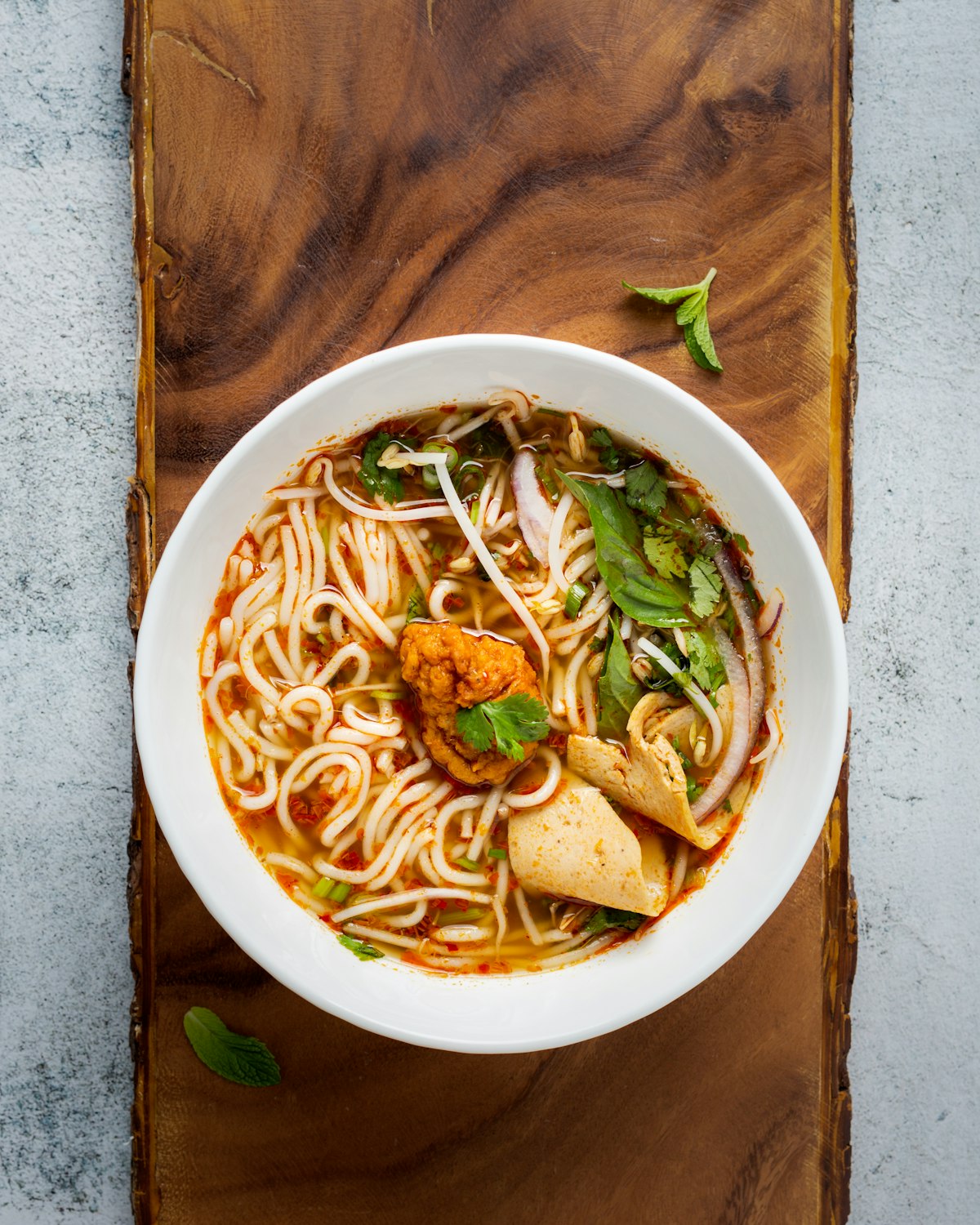
"Patience is the most important ingredient. The broth cannot be rushed — it must be earned."
This recipe is inspired by the stall-style bún bò Huế served in Huế’s morning markets — the kind of bowl that starts simmering before sunrise and sells out by mid-morning. It draws on traditional techniques and the practical rhythm of home cooks who know the dish by feel, by smell, and by the color of the oil.
The best version of this recipe is the one you adjust to your own taste after making it a few times. Cooking bún bò Huế is a practice, not a formula.
Overview
| Prep time | 45 minutes |
| Cook time | 6–8 hours (mostly unattended) |
| Servings | 6–8 bowls |
| Difficulty | Intermediate |
Part 1: The Broth
The broth is everything. It should be aromatic, deeply savory, slightly sweet, and warmly spiced — with a gorgeous amber-red color from the annatto chili oil.
Ingredients
- 2 lbs (900g) beef leg bones (or knuckle bones)
- 1.5 lbs (680g) beef shank, whole
- 1 lb (450g) pork hock, halved
- 8 stalks lemongrass, cut into 4-inch pieces and bruised
- 1 medium onion, halved and charred
- 3-inch piece ginger, halved and charred
- 3 tablespoons mắm ruốc Huế (fermented shrimp paste)
- 2 tablespoons fish sauce
- 1 tablespoon sugar
- 1 teaspoon salt (adjust later)
- 12 cups (3 liters) water
Steps
Step 1 — Clean the bones and meat.
Place beef bones and pork hock in a large pot, cover with cold water, and bring to a rolling boil. Let boil for 5 minutes — you'll see a lot of gray scum rise to the surface. Drain, rinse everything thoroughly under cold water, and scrub the pot clean.
This blanching step is critical. It removes impurities and blood that would make your broth cloudy and murky. Don't skip it.
Step 2 — Build the broth base.
Return the cleaned bones and pork hock to the pot. Add the beef shank, bruised lemongrass, charred onion, and charred ginger. Pour in 12 cups of fresh water.
Bring to a boil over high heat, then immediately reduce to a gentle simmer — you want lazy, occasional bubbles, not a rolling boil. A rolling boil emulsifies the fat and makes the broth cloudy.
Step 3 — Skim and simmer.
For the first 30 minutes, skim any foam or fat that rises to the surface. After that, the broth should settle into a clear, gentle simmer.
Step 4 — Add the seasonings.
After 1 hour of simmering, stir in the mắm ruốc Huế, fish sauce, and sugar. Dissolve the shrimp paste completely — press it against the side of the pot with a ladle if needed.
Step 5 — Remove the beef shank.
After about 2 hours, check the beef shank. It should be firm but tender when pierced with a chopstick. Remove it, submerge it in an ice bath for 10 minutes (this tightens the texture for cleaner slicing), then refrigerate until serving.
Step 6 — Continue simmering.
Let the broth continue simmering for 4–6 more hours total. The longer it goes, the deeper the flavor. Add water if the level drops below the bones. The finished broth should be fragrant, deeply savory, and slightly viscous from the gelatin.
Step 7 — Strain.
Strain the broth through a fine-mesh sieve. Discard the bones, lemongrass, onion, and ginger. Return the clear broth to the pot and keep warm.
Part 2: The Chili Lemongrass Oil (Sả Ớt)
This is the crown jewel — the fragrant, fiery, gorgeous oil that makes each bowl sing.
Ingredients
- ¼ cup neutral oil (vegetable or grapeseed)
- 2 tablespoons annatto seeds
- 3 tablespoons dried red chili flakes (Korean gochugaru works well)
- 2 stalks lemongrass, very finely minced
- 2 cloves garlic, minced
- Pinch of salt
Steps
- Heat the oil in a small saucepan over medium-low heat
- Add the annatto seeds and stir gently for 2–3 minutes until the oil turns a deep orange-red. Do not let them burn — they'll turn the oil bitter
- Strain out the seeds and return the orange oil to the pan
- Add the minced lemongrass and garlic. Sizzle gently for 3–4 minutes until fragrant
- Add the chili flakes and salt. Stir for 1 minute, then remove from heat
- Let cool slightly. The oil should be a vibrant reddish-orange with visible lemongrass and chili pieces
Store leftover oil in a jar in the refrigerator. It keeps for weeks and is incredible on everything — eggs, rice, grilled meats, even avocado toast.
Part 3: Preparing the Toppings
Noodles
- 1.5 lbs (680g) thick round rice vermicelli (bún bò Huế noodles)
If using dried noodles: soak in warm water for 30 minutes, then cook in boiling water for 5–8 minutes until tender but chewy. Drain and rinse with cold water.
If using fresh noodles: briefly blanch in boiling water for 30 seconds, then drain.
Meats
- Slice the chilled beef shank across the grain into thin pieces (about ⅛ inch thick)
- Separate the pork hock meat from the skin and bone; slice into bite-sized pieces
- Slice giò lụa (Vietnamese pork sausage) into ¼-inch rounds
The Herb Plate
The herb plate is central to every bowl. Arrange on a large platter:
- Shredded banana blossom (soak in lemon water to prevent browning)
- Torn spearmint leaves
- Bean sprouts
- Shredded cabbage
- Lime wedges
- Sliced Thai chilies
- Scallions, cut into 2-inch lengths
- Cilantro sprigs
- Thinly sliced white onion (soaked in ice water to mellow the bite)
Part 4: Assembly
This is the ritual. Each bowl is built with intention.
For each bowl:
- Noodles first. Place a generous nest of bún into a large, deep bowl
- Meats on top. Arrange slices of beef shank, pork hock, and sausage over the noodles
- Ladle the boiling broth. Pour the hot, strained broth over everything — enough to nearly submerge the noodles. The heat of the broth warms the meat and loosens the noodles
- Crown with chili oil. Spoon 1–2 tablespoons of the sả ớt over the top. Swirl it gently — watch the red oil bloom across the surface
- Garnish. Top with scallions, a sprinkle of sliced onion, and cilantro
Serve immediately with the herb plate on the side. Each person customizes their bowl — tearing herbs, squeezing lime, adding sprouts, adjusting heat.
Tips for Better Bún Bò Huế
Here are the practical lessons that experienced Huế cooks know by heart:
Never rush the broth. Low and slow. If the broth boils hard, it turns cloudy and loses clarity — gentle heat is the key.
Taste at every stage. The broth changes over hours. Taste at 2 hours, 4 hours, 6 hours. Adjust salt and fish sauce gradually.
The shrimp paste is your friend. Don’t be afraid of it. Start small, add more. If the broth tastes flat, it likely needs more mắm ruốc.
The herb plate is not decoration. It’s half the dish. A bowl without herbs is a bowl without balance.
Make it yours. Every stall in Huế makes the dish slightly differently, and the best home cooks develop their own signature over time. There is no single perfect bún bò Huế — only the one you make with care.
The Finished Bowl
When you sit down with your completed bowl — the broth steaming, the chili oil glistening, the herbs piled high — take a moment before you eat. Smell the lemongrass. Watch the oil swirl. Notice the colors: amber, crimson, green, white.
This is more than soup. This is a bowl of Vietnam's heart, simmered slowly and offered with generosity.
Chúc ngon miệng. Enjoy your meal.
🍜 Want to understand more about the culture behind this dish? Read The Art of Bún Bò Huế.